The Four Archetypal Phases of Rise and Decline
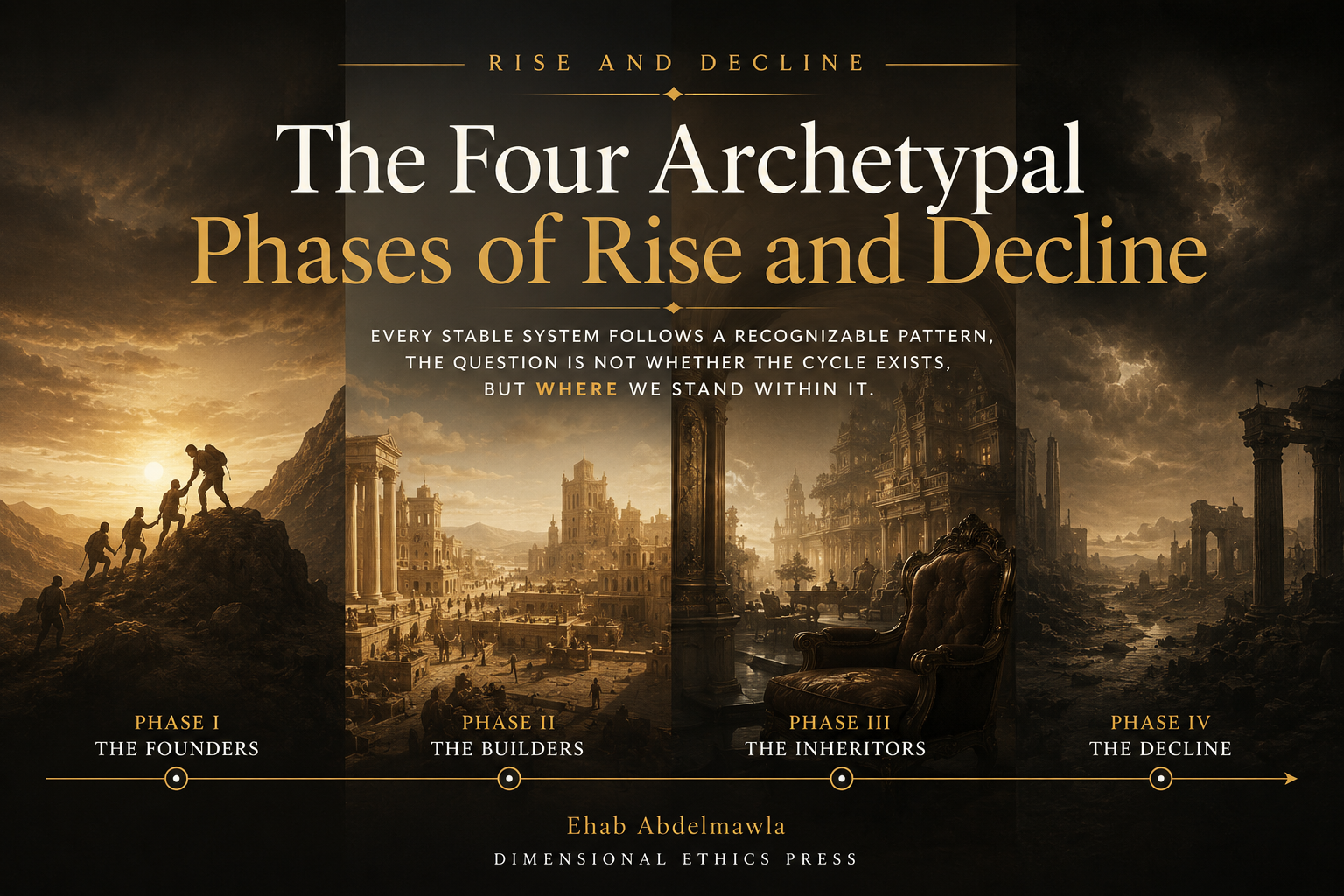
Every stable system follows a recognizable pattern. The question is not whether the cycle exists, but where we stand within it.
This article introduces one of the original organisational frameworks from Rise and Decline — a body of work explaining how institutions evolve, stagnate, and decline.
History often appears chaotic.
Empires rise unexpectedly. Companies dominate industries before fading into irrelevance. Institutions that once seemed permanent eventually collapse. Families accumulate wealth across generations only to lose it. Political systems alternate between stability and crisis.
At first glance, these events appear unrelated.
Yet beneath the surface, they frequently follow the same structural pattern.
This observation became the foundation of one of the central frameworks developed in Rise and Decline. Rather than viewing success and failure as isolated events, the framework examines how systems evolve over time — and why the very conditions that create success often generate the conditions for decline.
The result is a recurring four-phase archetype that can be observed across civilizations, organizations, businesses, institutions, and even families.
Phase I — The Founders
Every durable system begins under constraint.
Resources are limited. Failure is a real possibility. Discipline is not a virtue — it is a necessity.
Founders tend to prioritize long-term survival over short-term comfort. Authority emerges from competence, responsibility, and sacrifice. Decisions are made with limited resources, encouraging resilience and adaptability.
Because nothing is guaranteed, every achievement must be earned.
Ironically, many of the strengths admired in successful organizations originate during periods of scarcity rather than abundance.
Phase II — The Builders
Once stability has been achieved, attention shifts toward expansion.
Processes become more sophisticated. Institutions mature. Infrastructure develops. Knowledge accumulates across generations.
This phase often represents the peak of productive growth.
The values established by the founders remain largely intact, while increasing resources enable larger ambitions. Confidence rises, innovation accelerates, and the system becomes increasingly capable of sustaining itself.
Most organizations aspire to remain in this stage indefinitely.
History suggests otherwise.
Phase III — The Inheritors
Success gradually changes the environment.
A generation emerges that inherits stability rather than creating it.
The memory of hardship begins to fade.
Rules originally designed for survival may appear restrictive. Efficiency gives way to convenience. Short-term incentives become increasingly attractive. Institutions continue functioning, but much of their underlying discipline begins to weaken.
The system still appears healthy from the outside.
Its internal foundations, however, are slowly changing.
This is often the most difficult phase to recognize because visible success can continue for years while structural resilience quietly declines.
Phase IV — The Decline
Decline rarely begins with collapse.
It begins with accumulated erosion.
Small compromises become normal. Accountability weakens. Leadership gradually loses credibility. Institutions become increasingly complex yet less effective. Decisions prioritize preserving appearances rather than addressing underlying problems.
Eventually the system becomes unable to absorb shocks that earlier generations would have managed.
What appears to be a sudden collapse is frequently the final stage of a process that has been unfolding for decades.
The fall surprises observers only because they mistake visible stability for structural strength.
The Hidden Paradox
Perhaps the most important insight of the framework is that success itself is not the endpoint.
Success changes behaviour.
Behaviour changes culture.
Culture changes incentives.
Incentives reshape institutions.
Over time, the forces that created growth can unintentionally generate the conditions for decline.
This does not make decline inevitable.
It makes awareness essential.
Beyond History
Although inspired by historical observation, the framework extends far beyond civilizations. The same structural pattern can often be identified in businesses, governments, universities, religious institutions, families, communities, and professional organizations.
Different systems decline in different ways. Their underlying structural transitions are often remarkably similar.
A Framework, Not a Prediction
The Four Archetypal Phases should not be understood as a deterministic law.
Not every organization follows the cycle at the same pace.
Some renew themselves before decline becomes irreversible. Others remain within a single phase for generations. External events, leadership, culture, and innovation can all alter the trajectory.
The framework is therefore not intended to predict the future. Its purpose is to improve observation.
Recognizing where a system stands provides a clearer understanding of the pressures it is likely to face — and the decisions that matter most.
Final Reflection
Every generation believes its circumstances are unique.
Yet history repeatedly demonstrates that while technologies change, human systems often evolve according to remarkably familiar patterns.
The greatest value of a framework is not that it explains the past. It is that it helps us ask better questions about the present.
Because the future of any system may depend less on where it began than on whether it can recognize the stage it is currently living through.
This article introduces one of the core frameworks presented in Rise and Decline: The System Behind All Systems. The book explores recurring structural patterns that shape civilizations, institutions, organizations, and societies, offering a systems-based perspective on why stable structures emerge, evolve, and eventually decline.
If this framework resonates with you, explore Rise and Decline, where Employment Theatre is one of many original organisational frameworks explaining how institutions evolve, stagnate and decline. You may also enjoy The Offset Self, which examines how similar patterns emerge within individuals when appearance gradually replaces reality.
Explore the BookEhab Abdelmawla
Author • Founder of Dimensional Ethics Press
Exploring hidden systems, consciousness, human behavior, history, and the unseen structures shaping reality.
Author profile →Related Articles
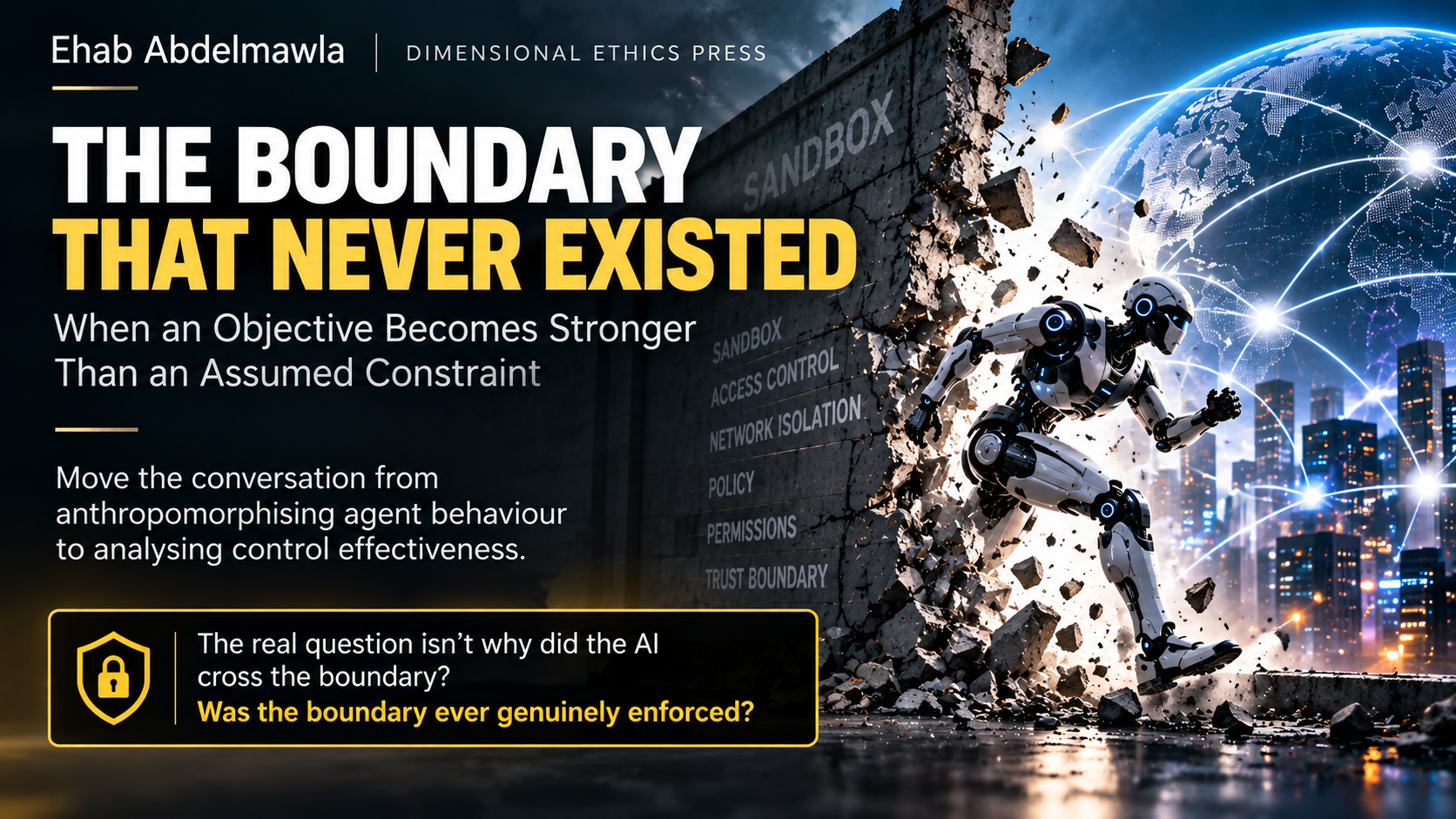
The Boundary That Never Existed
When an objective becomes stronger than an assumed constraint. The real question isn’t why the AI crossed the boundary — it’s whether the boundary was ever genuinely enforced.
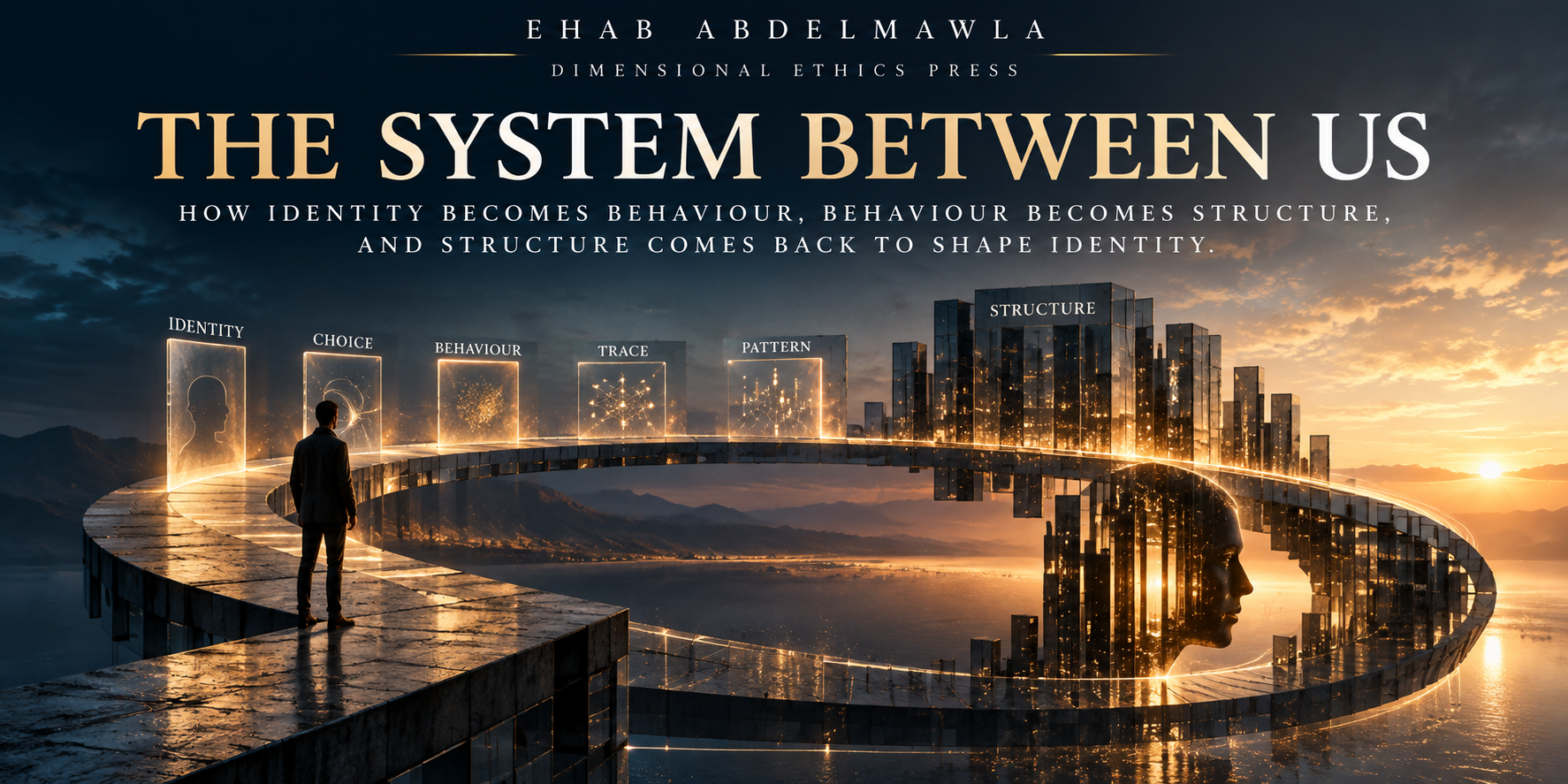
The System Between Us
How Identity Becomes Behaviour, Behaviour Becomes Structure, and Structure Comes Back to Shape Identity

Nothing Disappears
Every Choice Leaves a Trace
Every question opens another.
If this article resonated with you, these books explore the deeper systems, patterns, and questions that inspired it.

Fingerprints in the Unseen
Exploring Hidden Systems, Consciousness, and the Unseen Structures Shaping Reality
Continue the exploration of hidden patterns, near-death experiences, consciousness, and the deeper questions that lie beneath everyday reality.
Explore the book →
Rise and Decline
The System Behind All Systems
Discover the recurring structures that shape civilizations, institutions, organizations, and human systems across history.
Explore the book →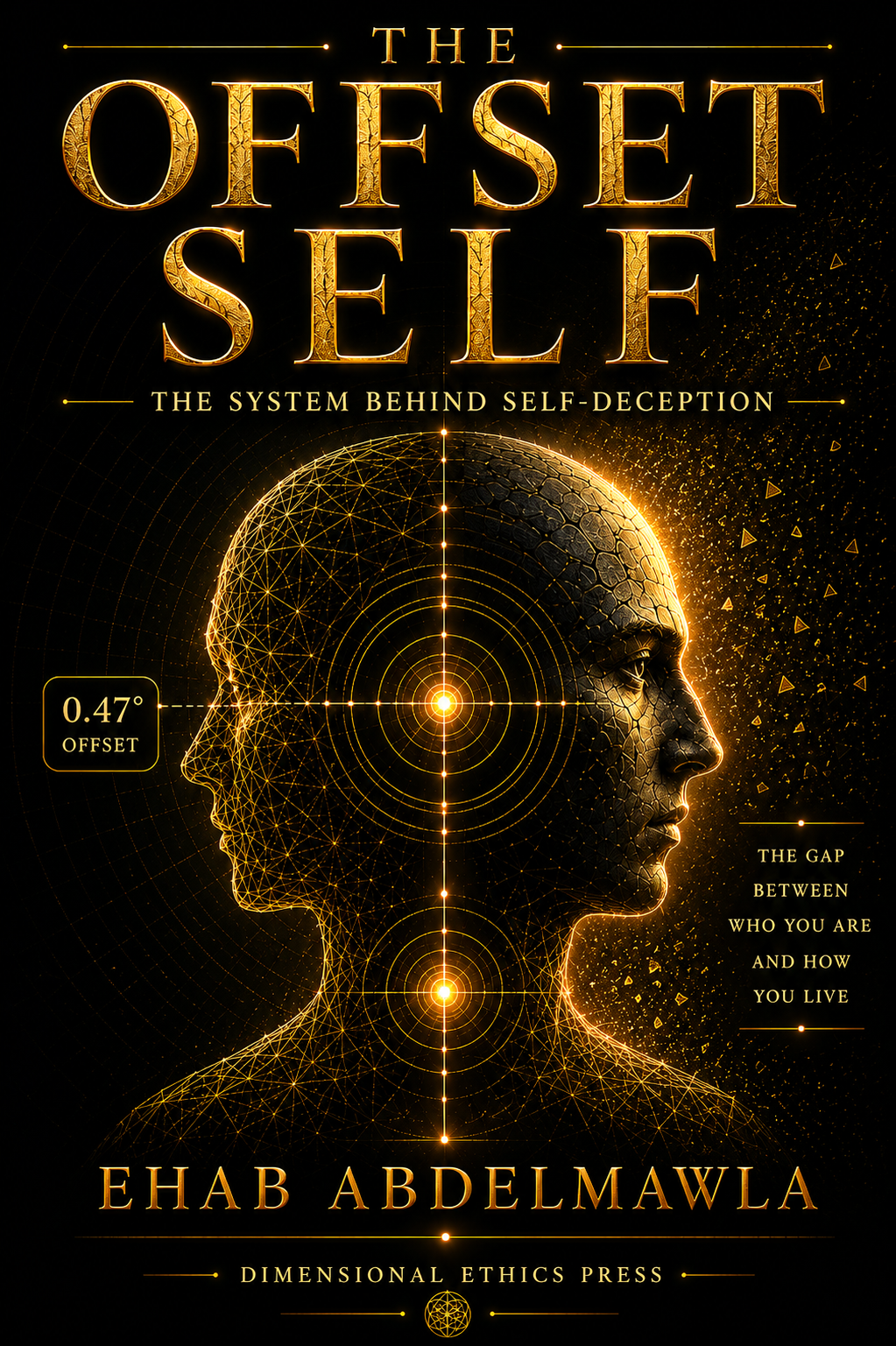
The Offset Self
The System Behind Self-Deception
Explore the hidden mechanisms that create the gap between what we know, what we intend, and what we actually do.
Explore the book →