The Architecture of Decline
When Success Becomes the System’s Greatest Vulnerability
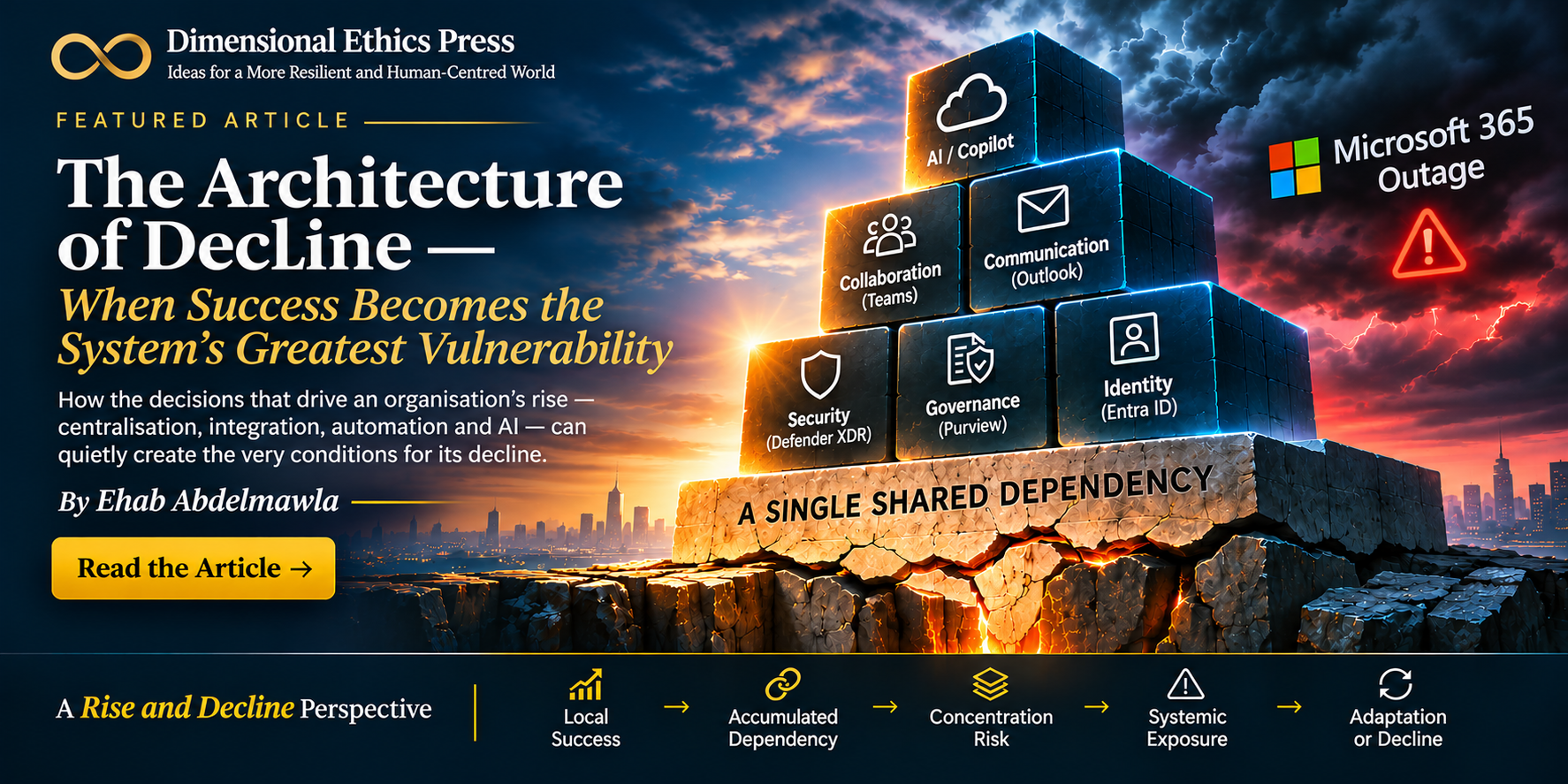
What if the decisions that make an organisation successful are the same decisions that eventually make it vulnerable?
The Paradox of Progress
An organisation invests millions in improving its resilience.
It migrates infrastructure to the cloud, centralises identity management, consolidates security platforms, automates compliance, integrates artificial intelligence and establishes comprehensive business continuity arrangements.
Each investment promises greater efficiency, stronger security, reduced operational costs and improved reliability.
Each initiative is independently justified.
Each department reports progress.
Management dashboards show improvement.
The organisation appears stronger than ever.
Then a major technology provider experiences an outage.
Suddenly, email becomes unavailable. Collaboration is disrupted. Security monitoring capabilities may be affected. Governance workflows encounter difficulties. Artificial intelligence services become inaccessible.
The organisation discovers that several supposedly independent capabilities depend on the same underlying infrastructure.
Its resilience arrangements may still exist.
Its policies remain approved.
Its controls remain documented.
But some of the mechanisms required to execute those controls are unavailable.
The organisation has not necessarily failed because it neglected resilience. It may have become vulnerable through the very decisions intended to strengthen it.
This is the paradox of progress.
And it reveals a deeper problem in how organisations understand success, risk and decline.
When One Failure Exposes an Entire System
The Microsoft 365 service disruptions reported in November 2026 provide a timely illustration of this problem.
The incident has raised questions about the concentration of enterprise dependencies across communication, collaboration, security, compliance and AI-enabled services.
The precise technical causes and full scope of the incident should be distinguished from the broader architectural risks it illustrates.
The important question is not whether every Microsoft service failed simultaneously.
Nor is it whether Microsoft is inherently less resilient than competing providers.
The more significant question is this:
How many supposedly independent organisational capabilities can become unavailable because they ultimately depend on the same operational foundation?
Consider a large enterprise.
Its communications team relies on Exchange Online.
Its employees collaborate through Teams.
Its security operations depend on cloud-hosted monitoring and investigation platforms.
Its compliance functions use integrated governance and information protection services.
Its business units increasingly rely on AI assistants connected to the same enterprise ecosystem.
Each capability may have a separate owner, budget, risk assessment and recovery procedure.
Yet their technical dependencies may overlap considerably.
An organisation can therefore possess multiple independently governed functions without possessing equivalent operational independence.
This distinction matters.
Administrative separation is not architectural independence.
And redundancy within a shared ecosystem is not necessarily protection against failure of that ecosystem.
The Rise and Decline Connection
In my book Rise and Decline, I explore how interacting forces shape the development, success, deterioration and eventual transformation of systems.
The central concern is not simply why organisations fail.
It is how the conditions associated with success can evolve into conditions that undermine the system itself.
A system is not merely the sum of its individual components.
Its behaviour emerges from the relationships, dependencies, incentives and accumulated decisions connecting those components.
This distinction becomes especially important when examining modern enterprise architecture.
An organisation rarely makes a deliberate decision to become excessively dependent on a single technology ecosystem.
Instead, dependency accumulates.
A business application is migrated because the cloud offers greater scalability.
Identity management is centralised because consistent authentication improves security.
Security monitoring is consolidated because integrated visibility improves detection and response.
Compliance workflows are automated because manual processes are inefficient.
AI capabilities are introduced because they improve productivity.
Every decision may be reasonable.
Every business case may be defensible.
Every implementation may meet its individual success criteria.
But the combined outcome may introduce a systemic vulnerability that none of those individual decisions was designed to evaluate.
This is where the distinction between local success and systemic success becomes critical.
A department can achieve its objectives while contributing to a condition that weakens the wider organisation.
The problem is not necessarily poor decision-making.
It is the absence of sufficient examination of the collective consequences of otherwise reasonable decisions.
When the Forces of Rise Become the Forces of Decline
One of the most important questions emerging from Rise and Decline is whether the forces responsible for a system’s growth can eventually work against its continued stability.
Consider the following progression.
Stage One: Improvement
An organisation begins by addressing genuine weaknesses.
Fragmented infrastructure is expensive.
Disconnected security tools reduce visibility.
Inconsistent governance creates compliance gaps.
Manual processes limit productivity.
Centralisation, integration and automation provide measurable benefits.
The organisation becomes more efficient, more consistent and potentially more secure.
These improvements are real.
Stage Two: Accumulation
Successful approaches are repeated.
More applications migrate to the same environment.
More business functions adopt the same identity infrastructure.
More controls become dependent on integrated platforms.
More operational processes rely on the same technology provider.
The organisation becomes increasingly interconnected.
But the growth in shared dependencies may not be accompanied by equivalent growth in independent recovery capabilities.
The system continues to improve according to its established performance indicators.
Its underlying exposure, however, may be changing.
Stage Three: Concentration
Over time, integration becomes dependency.
Dependency becomes concentration.
Concentration creates the possibility of common-mode failure.
Capabilities that appear independent at the organisational level become interconnected at the infrastructure level.
A single disruption may now affect multiple business functions simultaneously.
The system has become highly optimised for normal operating conditions.
But optimisation for normal conditions does not automatically establish resilience under abnormal conditions.
Stage Four: Exposure
An external disruption occurs.
The organisation discovers that some of its protective mechanisms rely on the infrastructure experiencing the disruption.
Its incident response procedures may depend on unavailable collaboration tools.
Its recovery documentation may reside in inaccessible systems.
Its security teams may experience reduced visibility through affected management interfaces.
Its business continuity arrangements may rely on communication channels sharing the same underlying dependencies.
The incident does not necessarily create these vulnerabilities.
It exposes vulnerabilities that accumulated during periods of apparent success.
Stage Five: Adaptation or Decline
What happens next determines whether the organisation learns.
One response is to restore services, close the incident, update the risk register and resume normal operations.
Another is to investigate why the failure propagated, which assumptions proved incorrect and whether existing resilience measures were genuinely independent.
The first response restores functionality.
The second creates the possibility of structural improvement.
This distinction is essential.
Recovery from an incident does not necessarily mean recovery from the conditions that made the incident consequential.
An organisation can return to normal operations while preserving the architecture of its next disruption.
The Illusion of Resilience
Modern organisations often measure resilience through the presence of controls.
Do we have a business continuity plan?
Do we have disaster recovery procedures?
Do we operate across multiple availability zones?
Do we maintain backups?
Do we have an incident response team?
Do we conduct regular audits?
These are necessary questions.
But they are insufficient.
A more fundamental question is whether those controls remain effective when the dependencies supporting them are unavailable.
A backup is valuable only if it can be accessed and restored when required.
An incident response plan is valuable only if the organisation can execute it under realistic failure conditions.
A security monitoring capability is valuable only to the extent that it remains sufficiently operational during the incidents it must help investigate.
A disaster recovery arrangement is valuable only if its recovery path does not reproduce the failure affecting the primary environment.
This leads to a critical distinction:
Control existence is not the same as control effectiveness. And control effectiveness under normal conditions is not proof of control effectiveness during systemic failure.
Organisations can accumulate extensive governance documentation while remaining insufficiently prepared for the conditions those documents are intended to address.
The result is not necessarily an absence of governance.
It can be a mismatch between documented assurance and operational reality.
The Danger of Measuring the Wrong Success
Perhaps the most concerning implication is that systemic vulnerability can increase while conventional performance indicators continue improving.
Consider an organisation reporting:
Lower infrastructure costs.
Higher employee productivity.
Faster application deployment.
Improved security integration.
Greater automation.
Reduced operational complexity.
These are legitimate achievements.
But what happens if the same transformation also increases the number of critical business functions dependent on a shared technology foundation?
The organisation may be measuring the benefits of integration without adequately measuring the concentration created by integration.
Its dashboards capture efficiency.
Its financial reports capture savings.
Its operational metrics capture productivity.
But the cumulative dependency remains insufficiently visible.
A system can become more successful according to the measurements it has chosen while becoming more vulnerable according to the conditions it has failed to measure.
This is one of the most consequential relationships between organisational performance and systemic decline.
Decline does not always announce itself through deteriorating results.
Sometimes it develops beneath improving results.
By the time the vulnerability becomes visible, the decisions responsible for creating it may have been celebrated as examples of successful transformation.
The Five Forces and the Problem of Collective Consequences
The broader Five Forces perspective developed in Rise and Decline encourages examination of systems through interacting influences rather than isolated events.
Applied to enterprise resilience, this means moving beyond the immediate technical cause of an outage.
A configuration error, software defect or infrastructure failure may explain why a particular service became unavailable.
But it does not fully explain why that failure affected an organisation to the extent it did.
That requires examining the forces shaping the organisation’s architecture over time.
Economic pressures encourage consolidation.
Operational pressures encourage standardisation.
Security requirements encourage centralised control.
Technological developments encourage integration.
Competitive pressures accelerate adoption.
These influences can reinforce one another.
None is inherently destructive.
Indeed, each may contribute substantially to organisational success.
The systemic problem emerges when their combined effects produce dependencies that are neither adequately understood nor deliberately managed.
The Five Forces perspective therefore shifts the investigation from a narrow question—
What caused the outage?
—to a broader one:
What conditions allowed one outage to become a significant organisational disruption?
The first question investigates an event.
The second investigates the system.
Both are necessary, but only the second can reveal vulnerabilities that existed long before the event occurred.
Centralisation Is Not the Enemy
It would be a mistake to conclude that organisations should abandon centralisation, cloud computing or integrated security platforms.
Centralisation can improve resilience.
A well-managed cloud environment may provide stronger availability, monitoring, security and recovery capabilities than fragmented infrastructure.
Similarly, distributing workloads across multiple providers does not automatically create independence.
Different providers can still share critical dependencies.
Multicloud architectures can introduce operational complexity, inconsistent controls, additional costs and new failure modes.
The objective should therefore not be decentralisation for its own sake.
It should be deliberate dependency management.
Organisations need to understand which capabilities must remain available during major disruptions and whether their recovery arrangements genuinely support that requirement.
This includes examining common-mode failures, alternative communication channels, independent access to recovery information, identity dependencies and the operational assumptions embedded within incident response arrangements.
The relevant measure is not how many resilience controls exist.
It is how effectively the organisation can continue operating when important parts of its normal environment are unavailable.
The System Must Be Able to Question Its Own Success
There is another dimension to this problem.
Organisations often conduct detailed reviews after failures.
But how frequently do they examine the unintended consequences of their successes?
When a transformation programme reduces costs and improves productivity, the organisation celebrates the achievement.
When a security consolidation initiative improves visibility, the organisation reports stronger controls.
When AI adoption accelerates business processes, the organisation measures the resulting efficiency.
These achievements deserve recognition.
But success should not exempt the underlying decisions from further examination.
The question should not end with whether the initiative delivered its intended benefits.
It should extend to what new dependencies, exposures or structural constraints emerged as a consequence.
This requires a governance culture capable of challenging successful decisions without treating such challenges as opposition to progress.
It also requires recognising that organisational resilience is not the responsibility of technology teams alone.
Architecture, security, risk, compliance, procurement, business continuity and executive leadership all influence the dependencies a system accumulates.
No single function can fully evaluate the collective outcome in isolation.
A system that can only recognise failure after something breaks is a system with limited capacity to understand its own development.
True organisational maturity requires the ability to identify emerging vulnerabilities even when conventional indicators continue showing success.
The Question Beyond Microsoft
The Microsoft incident will eventually be resolved.
Services will be restored.
Technical investigations will establish causes and contributing factors.
Organisations will assess the impact and review their recovery arrangements.
But the underlying question will remain.
What happens when the mechanisms designed to make an organisation efficient, secure and resilient become so interconnected that their independence is largely assumed rather than demonstrated?
This is not exclusively a Microsoft problem.
It is not exclusively a cloud problem.
It is not even exclusively a technology problem.
It is a systems problem.
The same pattern can emerge in financial institutions, governments, supply chains, healthcare systems and organisational governance structures.
Efficiency encourages consolidation.
Consolidation creates dependencies.
Dependencies can generate concentration.
Concentration can create systemic exposure.
And systemic exposure may remain hidden until the conditions supporting normal operations change.
The lesson is not that integration inevitably leads to decline.
It is that integration without sufficient understanding of collective dependencies can transform a source of strength into a source of vulnerability.
Conclusion: When Success Carries the Seeds of Decline
The most dangerous organisational vulnerabilities are not always created by obvious mistakes.
Some emerge from decisions that were individually correct, professionally justified and demonstrably successful.
The problem lies in their accumulation.
A system can strengthen its components while weakening the relationships between them.
It can improve efficiency while reducing independence.
It can expand governance while increasing reliance on shared infrastructure.
It can become more sophisticated while becoming less capable of operating outside its normal conditions.
This is why the relationship between rise and decline deserves examination beyond conventional measures of performance.
The forces that contribute to a system’s rise do not automatically remain beneficial as the system evolves.
Their consequences depend on how they interact, accumulate and reshape the conditions under which the system operates.
The central challenge is not to prevent progress.
It is to ensure that progress does not quietly undermine the foundations required to sustain it.
A system does not become resilient simply because every component has been designed for resilience. It becomes resilient when the failure of one component does not invalidate the protections of the others.
And perhaps the most important question is not whether an organisation is becoming more successful.
It is whether the organisation understands what its success is making it become.
Because sometimes, the architecture of decline is constructed during the most successful years of a system’s rise.
Exploring the forces that shape systems, behaviour, organisational evolution and the relationship between rise and decline.
Explore Rise and Decline →Ehab Abdelmawla
Author • Founder of Dimensional Ethics Press
Exploring hidden systems, consciousness, human behavior, history, and the unseen structures shaping reality.
Author profile →Related Articles

THE WORLD THAT CHOSE FOR US
What Happens When a Civilisation Becomes Too Successful to Question?

No One Above the System
Why accountability must increase with authority, not disappear behind it.
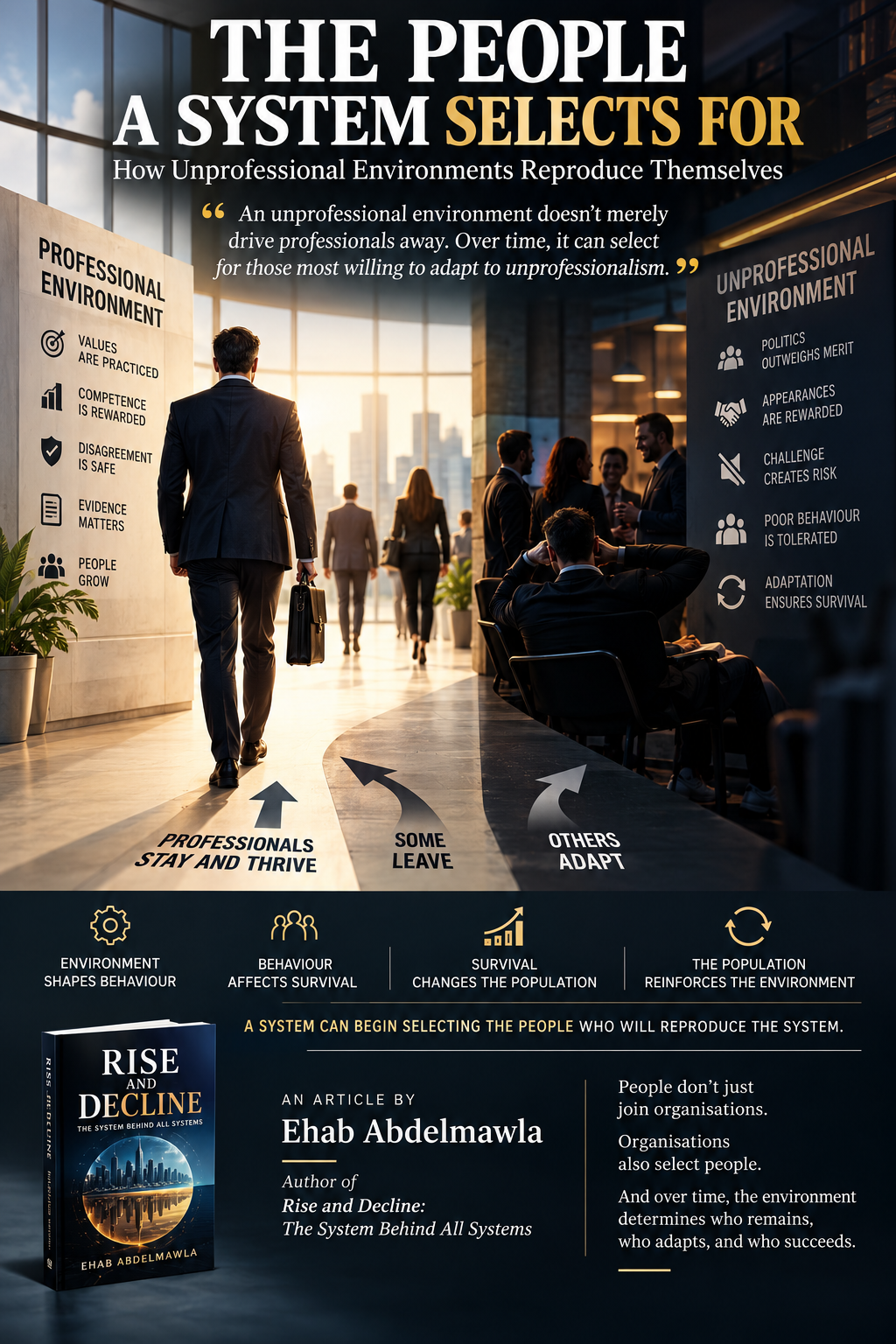
The People A System Selects For
How Unprofessional Environments Reproduce Themselves
Every question opens another.
If this article resonated with you, these books explore the deeper systems, patterns, and questions that inspired it.

Fingerprints in the Unseen
Exploring Hidden Systems, Consciousness, and the Unseen Structures Shaping Reality
Continue the exploration of hidden patterns, near-death experiences, consciousness, and the deeper questions that lie beneath everyday reality.
Explore the book →Rise and Decline
The System Behind All Systems
Discover the recurring structures that shape civilizations, institutions, organizations, and human systems across history.
Explore the book →
The Offset Self
The System Behind Self-Deception
Explore the hidden mechanisms that create the gap between what we know, what we intend, and what we actually do.
Explore the book →