Performance Theatre
When a System Measures the Truth but Cannot Afford to See It
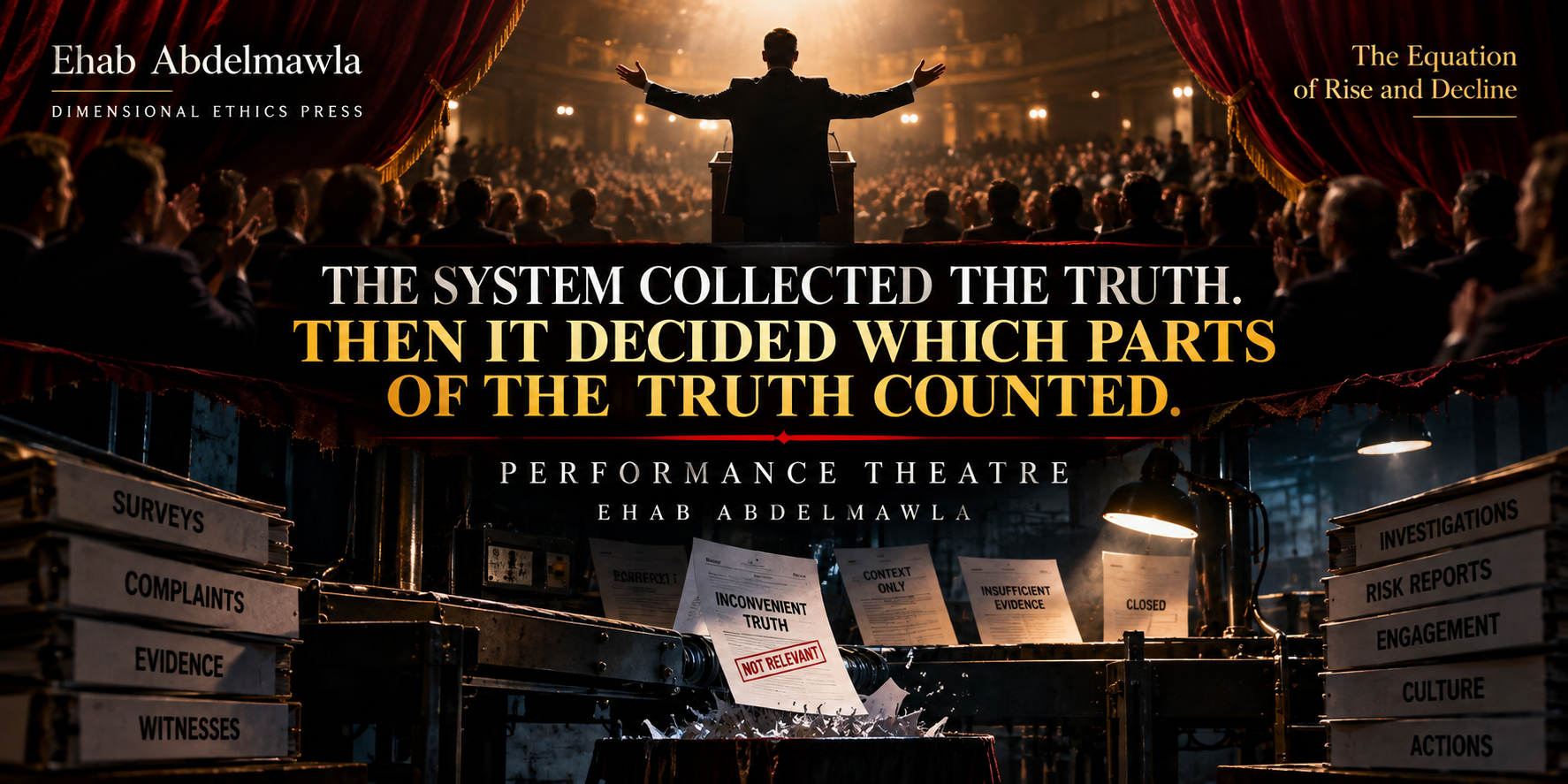
An organisation can have surveys, whistleblowing channels, risk registers, audits, incident reviews, HR processes, dashboards and governance committees—and still remain remarkably effective at not learning what they collectively reveal.
The problem is not always that evidence is hidden.
Sometimes the evidence is everywhere.
The problem is that the system has learned how to collect truth without allowing truth to change anything.
That is performance theatre.
The employee survey exists. The workplace-culture question is asked. The concern is recorded. The witness is interviewed. The evidence is collected. The investigation is completed. The governance box is checked.
Every component of accountability appears to be functioning.
And yet the underlying condition survives.
Selective Truth
Systems rarely need to fabricate evidence to protect themselves.
They can achieve something much more sophisticated simply by changing the weight given to different truths.
One witness is considered highly relevant. Another is peripheral.
One document is treated as contemporaneous evidence. Another becomes “context.”
One incident is examined microscopically while twelve months of preceding behaviour becomes background.
A survey result is statistically important when measuring engagement but anecdotal when someone asks what management behaviour produced it.
A high-performing employee’s work is useful when delivery is required but suddenly subjective when their professional credibility becomes inconvenient.
None of the individual decisions necessarily needs to be dishonest.
That is what makes the mechanism powerful.
A system can produce a distorted conclusion using individually defensible decisions.
The Architecture of Institutional Self-Protection
When evidence points toward a management or structural failure, acknowledging it can create secondary consequences.
If the problem is accepted, someone may have to ask:
Who knew?
How long had they known?
Were there earlier signals?
Were surveys already showing it?
Did somebody raise it previously?
Why was nothing changed?
Was the problem individual—or did the system enable it?
At that point, investigating the original problem creates another problem:
the investigation begins examining the institution itself.
The easiest organisational outcome can therefore become not proving that everything was perfect, but reducing the issue until it becomes administratively manageable.
A systemic pattern becomes a communication problem.
A leadership problem becomes an interpersonal disagreement.
A sequence becomes an incident.
A structural failure becomes a misunderstanding.
And once the frame becomes sufficiently small, the organisation can solve the smaller problem without confronting the larger one.
Why Collect Surveys If Nothing Changes?
This is where performance theatre becomes particularly visible.
Organisations spend enormous amounts of money measuring culture.
They measure engagement.
Workplace culture.
Leadership confidence.
Speaking up.
Trust.
Belonging.
Wellbeing.
Then the results enter dashboards, presentations and leadership meetings.
But measurement is not accountability.
A survey has value only if there is a functioning pathway between:
Signal → Investigation → Understanding → Intervention → Measurement
Break that chain anywhere and the survey becomes theatre.
The organisation can truthfully say:
“We listen to our people.”
What it cannot necessarily demonstrate is:
“What changed because we listened?”
That is a completely different standard.
The Evidence Paradox
More evidence does not automatically create more accountability.
Sometimes it creates more opportunities for selection.
Ten pieces of evidence create ten decisions about relevance.
Five witnesses create five decisions about credibility.
Three years of surveys create dozens of decisions about interpretation.
A sophisticated institution therefore does not need to suppress evidence.
It merely needs to fragment it.
Each item can be assessed separately.
Each incident can have an alternative explanation.
Each survey can contain methodological limitations.
Each witness can have incomplete visibility.
Each decision can be reasonable in isolation.
The pattern disappears because the system never permits the pieces to become a system.
And this produces one of the most dangerous sentences in organisational life:
“There is insufficient evidence of a broader issue.”
Sometimes that conclusion is correct.
But sometimes the broader issue disappeared precisely because every piece of evidence was required to prove the whole thing independently.
The Cost
Performance theatre initially protects stability.
It prevents disruption.
It avoids difficult conversations.
It protects established structures.
It reduces immediate organisational discomfort.
But the protection has a cost.
Good people stop speaking.
Surveys become rituals.
Risk reporting becomes defensive.
Employees learn which truths are safe to raise.
Managers learn which metrics matter more than underlying reality.
Eventually, leadership receives cleaner information precisely because the organisation has become less healthy.
That is when the system begins confusing silence with alignment.
And in the framework I developed in The Equation of Rise and Decline, that distinction matters enormously.
A system does not decline simply because problems exist.
Every system has problems.
Decline begins when its internal mechanisms stop converting reality into correction.
The Real Test
The strength of an institution should therefore not be measured by how many mechanisms it has for collecting truth.
The harder question is:
What happens when the truth those mechanisms produce becomes inconvenient?
Does the organisation widen the investigation?
Does it connect evidence across time?
Does it examine its own assumptions?
Does it distinguish legitimate disagreement from disloyalty?
Does it ask whether management itself contributed to the problem?
Does it allow evidence to challenge the structure that commissioned the investigation?
Or does the machinery of accountability quietly become the machinery through which accountability is avoided?
Because the most dangerous system is not one that cannot see its failures.
It is one that can see them clearly—
and has become exceptionally sophisticated at explaining why they do not count.
The Equation of Rise and Decline
Performance Theatre explores one of the central problems within the Rise and Decline framework: a system can possess extensive feedback mechanisms and still decline when those mechanisms no longer convert reality into correction.
Outcome = Alignment × Timing ÷ Pressure
Alignment = Direction × Incentives × Structure × Adaptation × Feedback
Explore the broader framework in:
Rise and Decline
The System Behind All Systems
By Ehab Abdelmawla
Ehab Abdelmawla
Author • Founder of Dimensional Ethics Press
Exploring hidden systems, consciousness, human behavior, history, and the unseen structures shaping reality.
Author profile →Related Articles
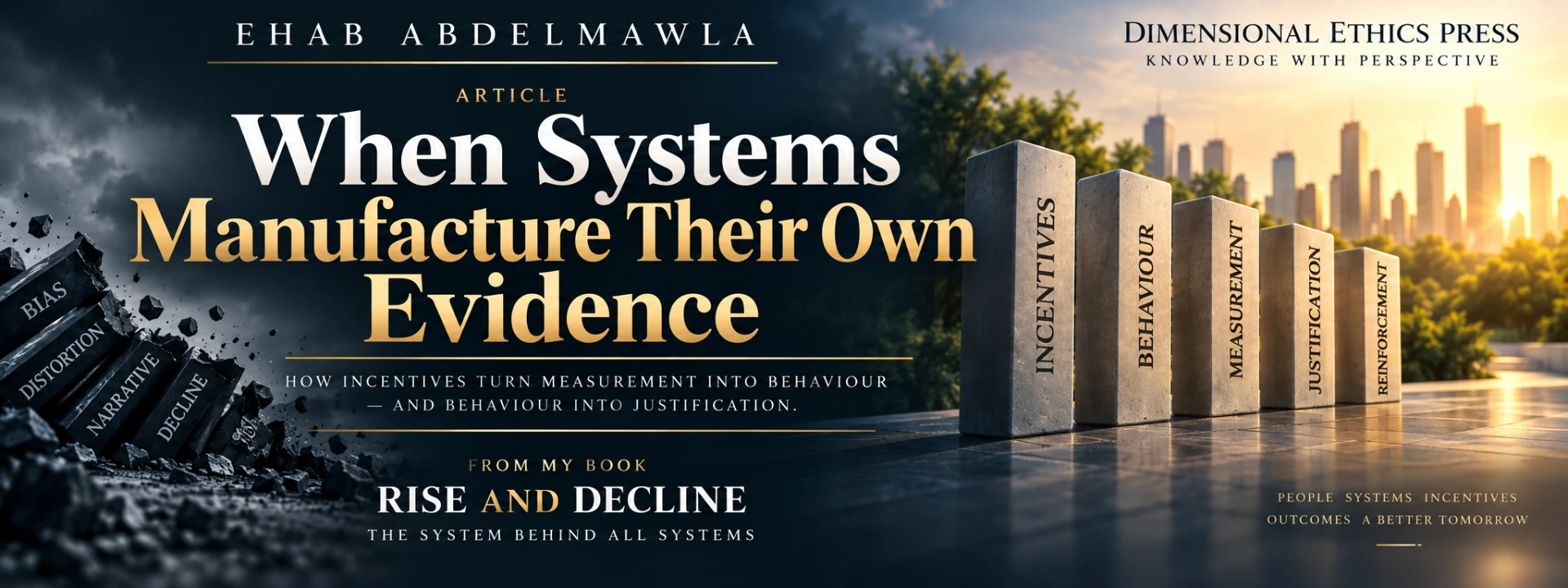
When Systems Manufacture Their Own Evidence
How incentives turn measurement into behaviour — and behaviour into justification.
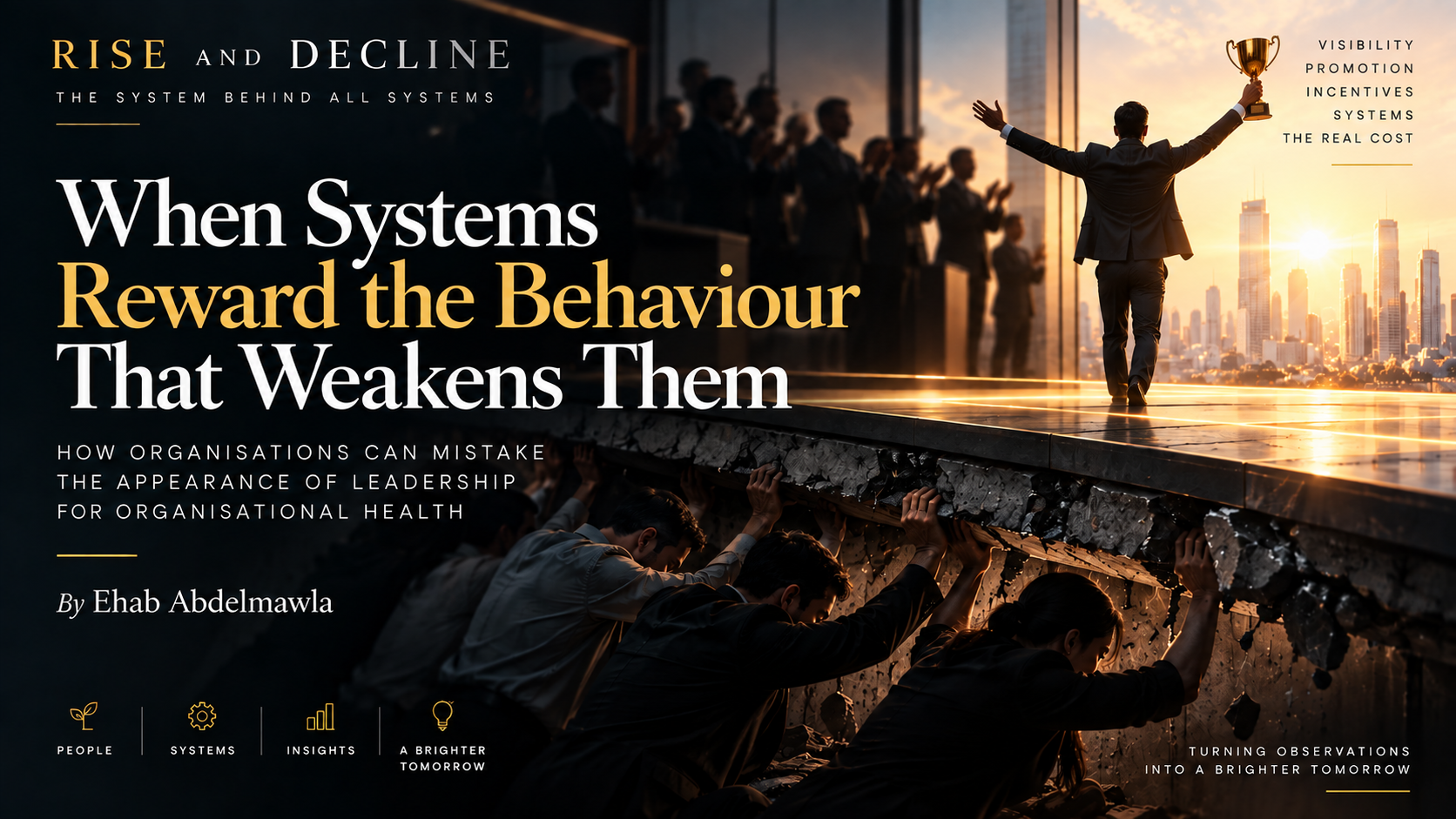
When Systems Reward the Behaviour That Weakens Them
How organisations can mistake the appearance of leadership for organisational health
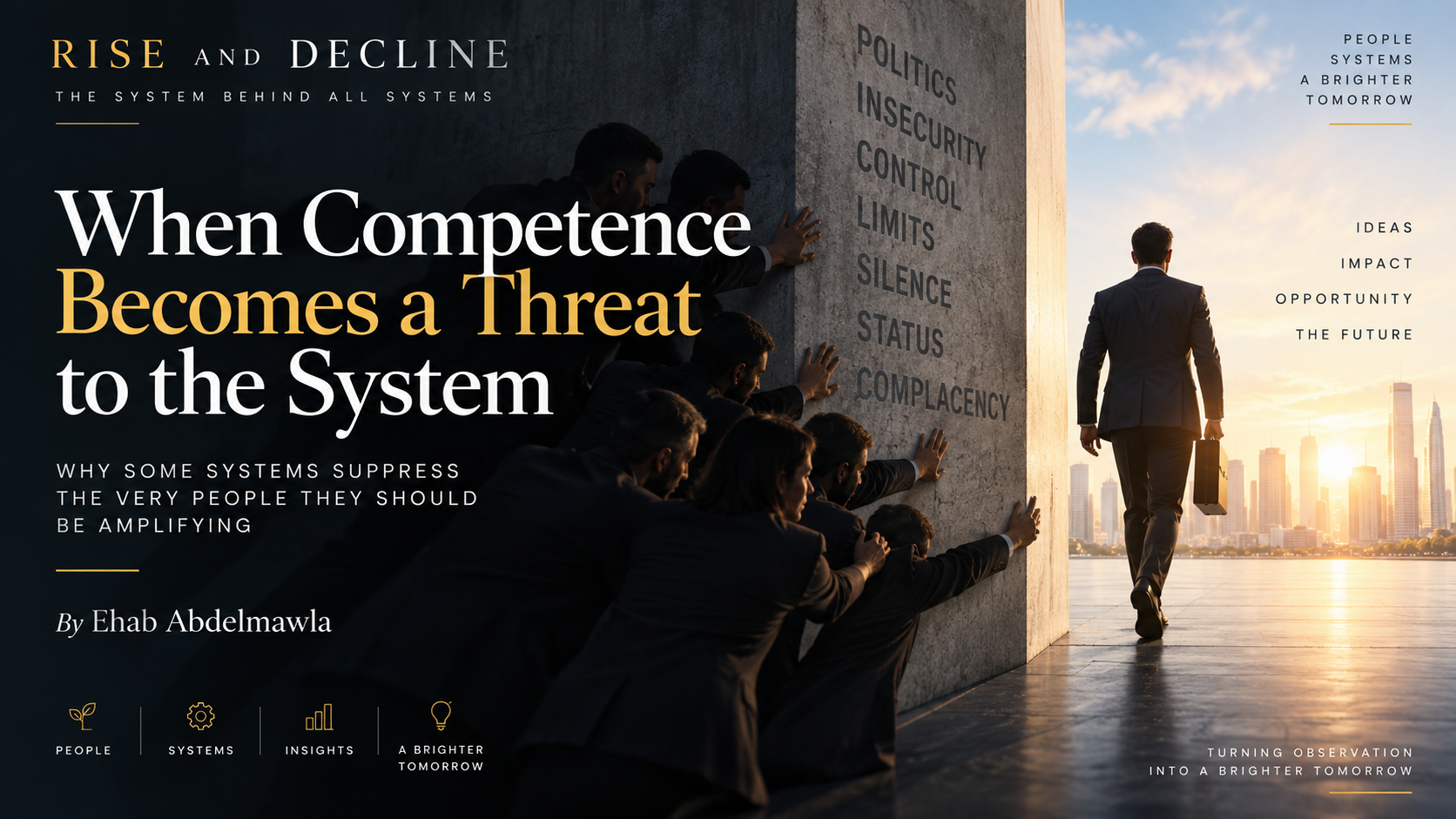
When Competence Becomes a Threat to the System
Why some systems suppress the very people they should be amplifying
Incentives Shape Systems More Than Intentions
Systems rarely become what they intend to be. They become what they reward.
Every question opens another.
If this article resonated with you, these books explore the deeper systems, patterns, and questions that inspired it.

Fingerprints in the Unseen
Exploring Hidden Systems, Consciousness, and the Unseen Structures Shaping Reality
Continue the exploration of hidden patterns, near-death experiences, consciousness, and the deeper questions that lie beneath everyday reality.
Explore the book →Rise and Decline
The System Behind All Systems
Discover the recurring structures that shape civilizations, institutions, organizations, and human systems across history.
Explore the book →
The Offset Self
The System Behind Self-Deception
Explore the hidden mechanisms that create the gap between what we know, what we intend, and what we actually do.
Explore the book →