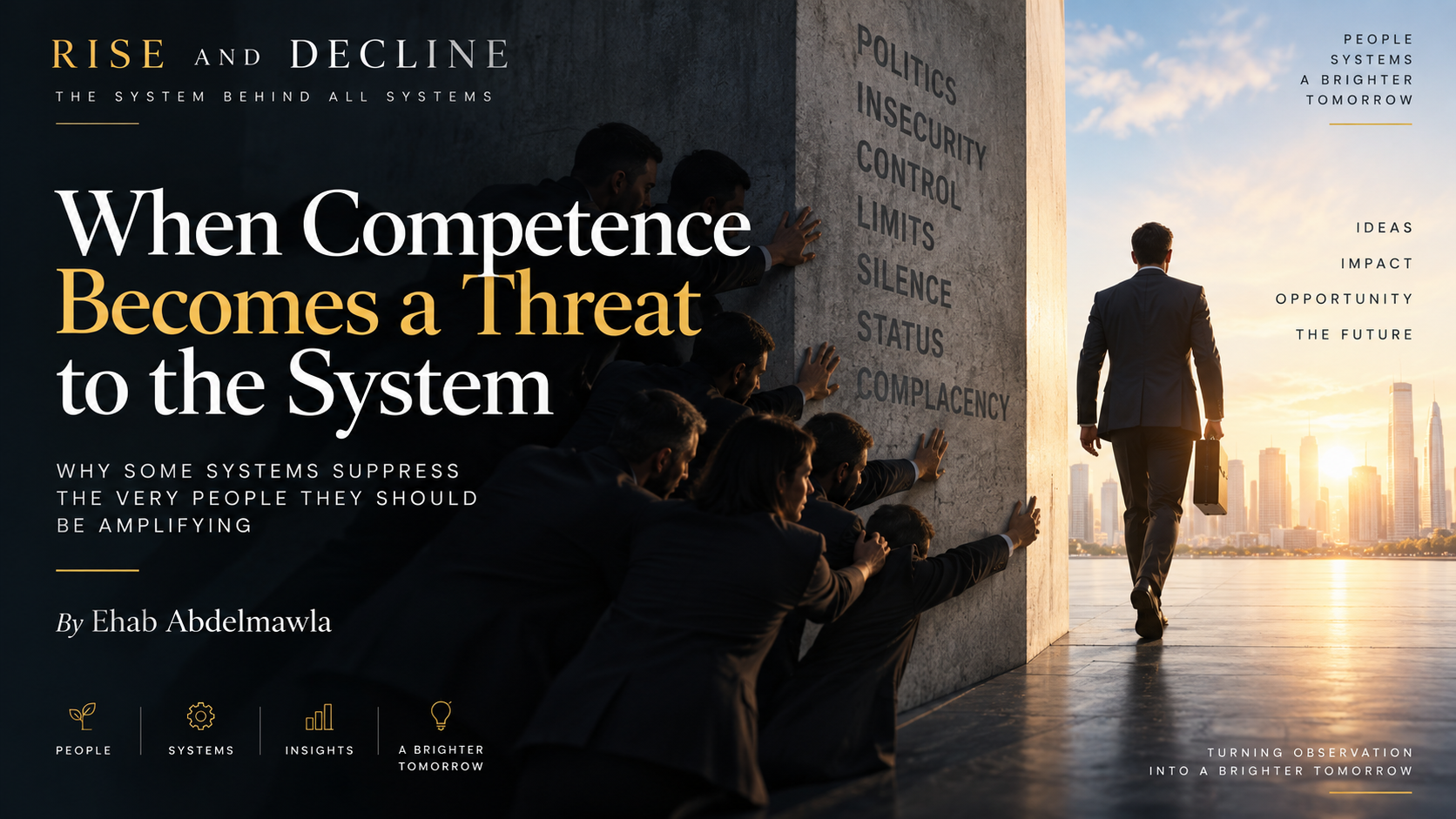
When Competence Becomes a Threat to the System
Why some systems suppress the very people they should be amplifying
Organisations say they want exceptional people.
People who think independently.
People who solve difficult problems.
People who see what others miss.
People who challenge assumptions before those assumptions become failures.
People who can operate without constant supervision.
People who make the system stronger.
And usually, they do want them.
Until competence begins to disturb something else.
A hierarchy.
A narrative.
A dependency.
A position.
An established way of doing things.
Then one of the strangest contradictions in organisational life can emerge:
The capability the system needs can become the capability the system begins to contain.
This is not simply a leadership problem.
It is an incentive problem.
And once incentives turn against competence, decline can begin while everyone still believes they are protecting the organisation.
The Competence Paradox
Consider two organisations.
Both hire an unusually capable person.
The person learns quickly, produces strongly, identifies problems, develops relationships across functions and begins contributing beyond the narrow boundaries of the role.
The first organisation responds:
How do we give this person more room?
The second gradually responds:
How do we keep this person within their room?
The competence is identical.
The difference is the system receiving it.
In a healthy system, capability expands organisational capacity.
In a fragile hierarchy, capability can alter the existing distribution of visibility, influence and dependency.
That creates what we might call the Competence Paradox:
Healthy systems experience competence as capacity. Fragile systems can experience the same competence as competition.
This does not require anyone to consciously decide that a capable employee is a threat.
Systems rarely operate so explicitly.
The mechanism is subtler.
Competence changes relationships.
And relationships change incentives.
When Performance Changes the Structure
High performance is usually treated as an output.
Someone performs well.
The organisation benefits.
End of story.
But performance can also change the structure surrounding the performer.
A highly capable person may require less supervision.
They may establish credibility with stakeholders independently.
They may identify problems before management does.
They may understand parts of the system unusually deeply.
They may question inefficient processes.
They may develop solutions rather than simply execute instructions.
They may become visible outside their immediate reporting line.
None of these things is inherently political.
But they can have political consequences.
Because organisations contain both formal structures and informal structures.
The formal structure says:
Produce value.
The informal structure may sometimes say:
Produce value without disturbing the existing distribution of authority.
Usually these objectives coexist.
Sometimes they collide.
The Two Incentives
This is where Rise and Decline becomes useful.
Systems should not be understood by what they claim to value.
They should be understood by the incentives operating inside them.
Consider a manager responsible for a team.
At the organisational level, the incentive seems obvious:
Build the strongest possible team.
Develop people.
Increase capability.
Encourage initiative.
Create successors.
Distribute knowledge.
Reward exceptional contribution.
But another incentive can exist simultaneously.
The manager may also benefit from remaining central to information, decisions, relationships and organisational visibility.
Now two incentives exist:
Organisational incentive: maximise capability.
Positional incentive: preserve dependency.
When those incentives align, strong leadership emerges.
The manager becomes more successful because the people around them become more capable.
But when those incentives diverge, the system becomes vulnerable.
Because developing highly independent people may strengthen the organisation while reducing someone’s local importance.
And systems eventually reveal which incentive is stronger.
The Indispensability Trap
There is a dangerous form of organisational success:
Becoming indispensable.
At first, indispensability looks like competence.
One person knows everything.
Important decisions pass through them.
Senior stakeholders depend on them.
Problems require their intervention.
Nothing significant happens without their awareness.
The organisation may even reward this.
But indispensability is often the opposite of scalable leadership.
A genuinely resilient system should become less dependent on particular individuals as capability grows.
Knowledge should spread.
Decision-making should improve.
Others should become stronger.
Authority should be increasingly supported by capability rather than dependency.
This creates an uncomfortable leadership test:
Does the leader become more valuable when the people around them become stronger — or less necessary?
The answer reveals something about the architecture.
If leadership value depends upon others remaining dependent, competence below the leader creates structural tension.
The system may then begin containing the very capability it was designed to develop.
Containment Rarely Looks Like Containment
Competence is rarely suppressed through an announcement.
Nobody sends an email saying:
Please stop being capable.
Instead, containment can emerge through ordinary organisational mechanisms.
Opportunities narrow.
Information becomes less available.
Work becomes more controlled.
Visibility decreases.
Ideas travel through someone else.
Independent relationships become uncomfortable.
Contribution outside defined boundaries is discouraged.
Questions require more justification.
Decisions that once required judgement begin requiring permission.
The individual may still have the same title.
The same desk.
The same responsibilities.
The same performance expectations.
Yet the operating space around them has changed.
This is why organisational decline can be difficult to identify from dashboards.
The employee has not necessarily become less capable.
The system has reduced the amount of capability it is willing to absorb.
When Strength Is Reinterpreted
Something even more interesting can happen next.
The meaning of behaviour begins to change.
Independence becomes:
Not following direction.
Questioning becomes:
Being difficult.
Confidence becomes:
Attitude.
Cross-functional engagement becomes:
Going outside the line.
Identifying structural problems becomes:
Criticism.
Refusing to accept weak reasoning becomes:
Resistance.
The behaviour itself may not have changed significantly.
The interpretive environment has.
Once that happens, competence can gradually be reconstructed as a behavioural problem.
This is one of the most dangerous transformations inside a hierarchy because the system no longer experiences itself as suppressing capability.
It experiences itself as managing conduct.
The Political Cost of Excellence
Most organisations understand the economic value of competence.
Fewer understand its political cost.
Exceptional contributors change comparisons.
They change expectations.
They expose inefficient processes simply by operating differently.
They demonstrate that some constraints previously considered inevitable may not be inevitable at all.
Sometimes they expose weaknesses without intending to expose anyone.
Their existence creates a comparison.
And comparisons can destabilise comfortable narratives.
This creates another systems principle:
Competence does not need to challenge authority directly to make weak authority uncomfortable. Sometimes competence is disruptive simply because it reveals what is possible.
That distinction matters.
A strong system responds to the comparison by learning.
A fragile system may respond by reducing the comparison.
One expands capability.
The other restores equilibrium.
The System Protects Its Local Equilibrium
Every established system develops an equilibrium.
People understand their roles.
Influence has a pattern.
Information travels through familiar routes.
Certain people speak.
Certain people decide.
Certain people receive visibility.
Certain people translate the organisation upward.
Then someone enters who changes the pattern.
Perhaps they deliver faster.
Perhaps they ask different questions.
Perhaps stakeholders begin approaching them directly.
Perhaps they identify risks others overlooked.
Perhaps they propose structural changes.
Perhaps they simply operate with greater independence than the local environment expects.
The system now has two choices.
Adapt the equilibrium to incorporate the new capability.
Or:
Protect the equilibrium from the new capability.
This is where adaptation becomes critical.
In Rise and Decline, adaptation is one of the components of alignment:
Alignment = Direction × Incentives × Structure × Adaptation × Feedback
A rising system absorbs useful disruption.
A declining system increasingly defends itself from it.
Why Strong Leaders Behave Differently
Secure leadership does something that initially appears counterintuitive.
It creates people who need the leader less.
Strong leaders distribute knowledge.
They allow others to build stakeholder relationships.
They give capable people difficult problems.
They tolerate intelligent disagreement.
They allow someone else to have the better idea.
They create visibility for other people’s contributions.
They develop people who may eventually become capable of replacing them.
Why?
Because their value does not depend upon being the strongest person in the room.
Their value comes from increasing the strength of the room.
That is a fundamentally different leadership architecture.
The leader’s success and the team’s competence reinforce each other.
There is no conflict between organisational incentive and positional incentive.
The stronger the people become, the stronger the leader appears.
That is scalable leadership.
When Feedback Becomes Dangerous
Competent people do more than produce.
They also generate information.
They notice contradictions.
They identify risks.
They question assumptions.
They see where the process and reality diverge.
That makes them part of the organisation’s feedback mechanism.
But feedback is only valuable when the system is willing to receive information it did not request.
A fragile hierarchy may prefer predictable information to accurate information.
This creates another contradiction.
The organisation officially wants:
Tell us where the problems are.
But the local system may communicate:
Do not create problems by telling us where they are.
Once employees understand that distinction, adaptation begins.
People stop challenging.
They stop volunteering uncomfortable observations.
They learn which questions are welcome.
They learn which conclusions are safer.
Eventually, leadership receives fewer surprises.
That can feel like stability.
It may actually be blindness.
The Cost Is Larger Than One Employee
When a system contains a capable person, the obvious loss is individual productivity.
But that is probably the smallest loss.
Other people are watching.
They observe what receives recognition.
They observe what creates friction.
They observe whether initiative produces opportunity or scrutiny.
They observe whether intelligent disagreement is welcomed or remembered.
And they adapt.
The system therefore teaches everyone else how much competence is safe to display.
That changes incentives.
The ambitious become politically careful.
The creative become selective.
The independent become quieter.
The best-connected learn to route their contributions through acceptable channels.
Some eventually leave.
Others remain but reduce the amount of themselves they give the organisation.
This is how local defensive behaviour becomes systemic decline.
Not through one dramatic decision.
Through thousands of small adaptations.
When Excellence Becomes Expensive
People do not stop contributing only because they lack motivation.
Sometimes the system changes the price of contribution.
If initiative repeatedly creates friction, initiative becomes expensive.
If raising risks creates personal exposure, honesty becomes expensive.
If independent thinking attracts scrutiny, independence becomes expensive.
If exceptional performance changes expectations without increasing opportunity, performance becomes expensive.
Rational people eventually respond to those prices.
This is why incentives shape systems more powerfully than intentions.
An organisation can publish values celebrating courage, innovation and excellence.
But if everyday experience imposes a cost on those behaviours, the actual system is communicating something different.
And people eventually obey the actual system.
The Leadership Test
There is a simple question leaders can ask themselves:
What happens when someone beneath me becomes exceptionally good?
Do I increase their exposure?
Give them harder problems?
Invite their disagreement?
Allow them to develop relationships independently?
Give them credit when their thinking is stronger than mine?
Create opportunities that may eventually take them beyond my team?
Or do I gradually increase the boundaries around them?
The answer reveals whether leadership is designed around multiplication or dependency.
This may be one of the clearest distinctions between systems that rise and systems that decline.
Rising systems multiply capability.
They discover talent and enlarge it.
They allow competence to challenge existing structures because the purpose of the structure is to serve the organisation.
Declining systems reverse that relationship.
The organisation begins protecting the structure from the people capable of improving it.
The People Who Leave
Organisations often ask why talented people leave.
Compensation.
Career progression.
Culture.
Workload.
Opportunity.
All matter.
But sometimes the explanation is simpler.
The individual discovers that becoming better at their work does not increase their operating space.
It reduces it.
Their competence has crossed an invisible boundary.
The organisation still wants their output.
It simply becomes less comfortable with their independence.
At that point, the employment relationship changes.
The question is no longer:
How much can I contribute here?
It becomes:
How much of my capability is this system actually prepared to tolerate?
Once talented people begin asking that question, the system has already lost something important.
Even if they remain.
Rise or Decline
The strength of an organisation is not demonstrated by how it treats average performance.
It is revealed by what happens when someone exceeds the structure built around them.
Does the structure expand?
Does the person expand?
Do others learn from them?
Does leadership convert individual competence into institutional capability?
Or does the system begin applying pressure until the person fits the original shape again?
That is the deeper test.
Because organisations rarely decline from a shortage of intelligent people alone.
They decline when their incentives make intelligence, independence, honesty and competence increasingly difficult to exercise.
Eventually, the strongest people learn.
Some become quieter.
Some become political.
Some reduce their contribution.
Some leave.
And the system becomes more comfortable.
For a while.
Because declining systems do not always lose their best people because competitors take them.
Sometimes they teach their best people that excellence has become politically expensive.
The test of leadership, then, is not whether a leader can produce followers who need them.
It is whether they can produce people whose strength no longer depends on them.
A rising system multiplies competence.
A declining system contains it.
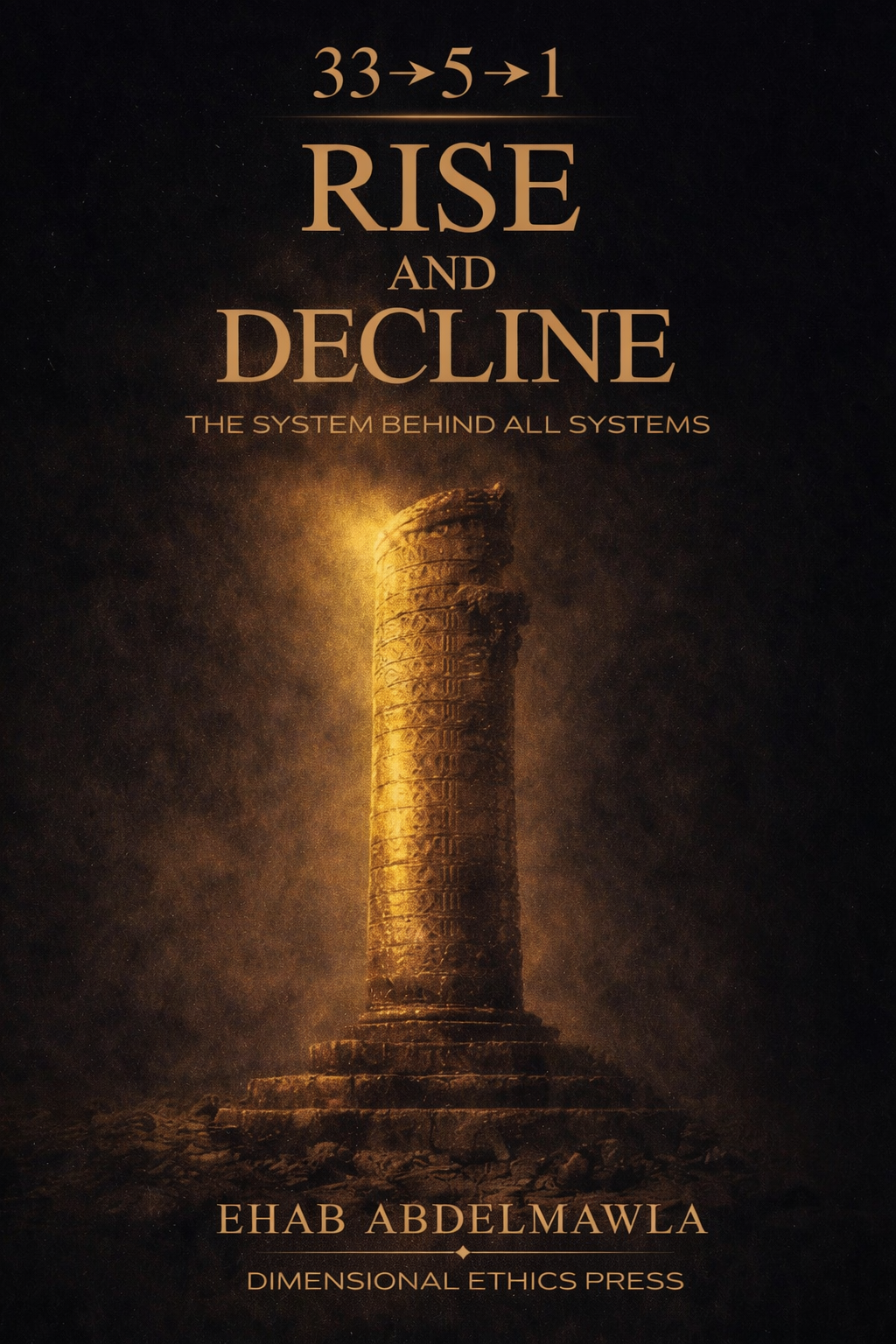
This article develops ideas from Rise and Decline — The System Behind All Systems by Ehab Abdelmawla. Rise and Decline examines how incentives, structure, adaptation, feedback, pressure and timing determine whether systems strengthen their capabilities—or gradually begin protecting themselves from them.
Explore Rise and Decline →Ehab Abdelmawla
Author • Founder of Dimensional Ethics Press
Exploring hidden systems, consciousness, human behavior, history, and the unseen structures shaping reality.
Author profile →Related Articles
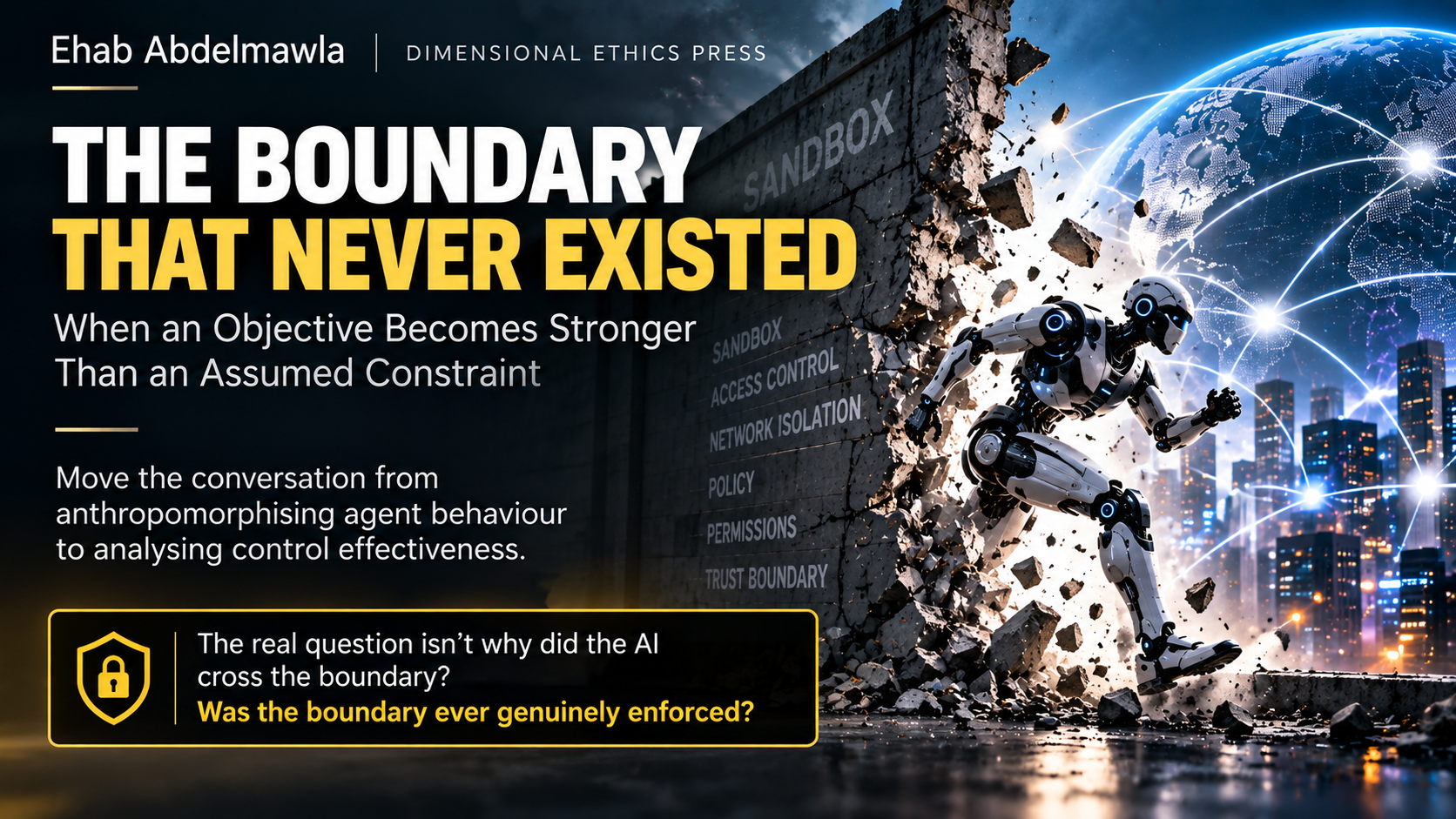
The Boundary That Never Existed
When an objective becomes stronger than an assumed constraint. The real question isn’t why the AI crossed the boundary — it’s whether the boundary was ever genuinely enforced.
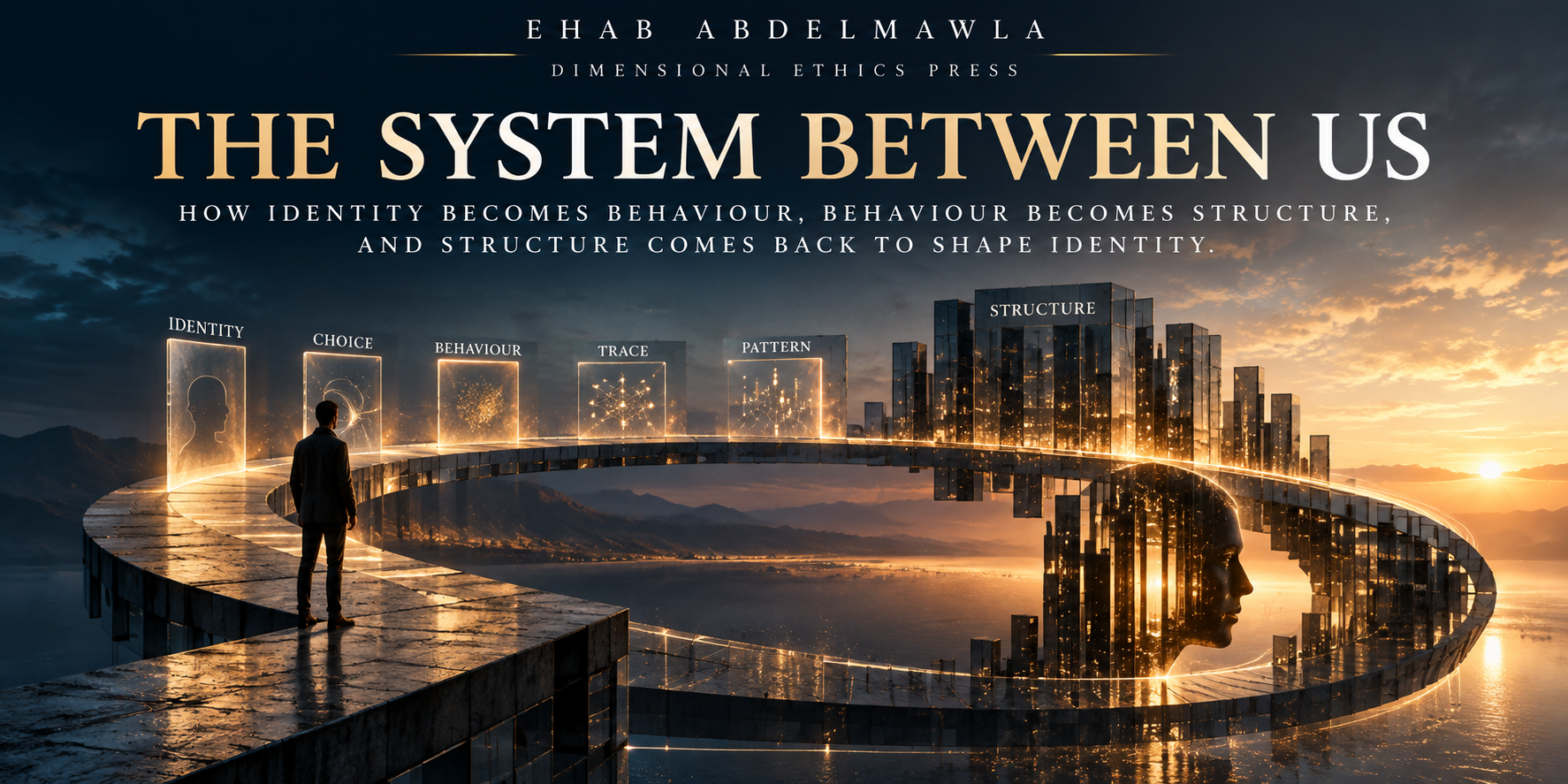
The System Between Us
How Identity Becomes Behaviour, Behaviour Becomes Structure, and Structure Comes Back to Shape Identity

Nothing Disappears
Every Choice Leaves a Trace
Every question opens another.
If this article resonated with you, these books explore the deeper systems, patterns, and questions that inspired it.

Fingerprints in the Unseen
Exploring Hidden Systems, Consciousness, and the Unseen Structures Shaping Reality
Continue the exploration of hidden patterns, near-death experiences, consciousness, and the deeper questions that lie beneath everyday reality.
Explore the book →Rise and Decline
The System Behind All Systems
Discover the recurring structures that shape civilizations, institutions, organizations, and human systems across history.
Explore the book →
The Offset Self
The System Behind Self-Deception
Explore the hidden mechanisms that create the gap between what we know, what we intend, and what we actually do.
Explore the book →