
The Offset Self Theory
Interlude — Before the Theory
There is a particular kind of human fracture that is difficult to see. Not because it is rare, but because it functions.
A person can work, respond, perform, adapt, participate, and continue moving through life while gradually losing continuity within themselves. This is not dramatic fragmentation. It is functional fragmentation: the kind that allows life to continue while the distance between who we understand ourselves to be and how we repeatedly live becomes wider.
At first, The Offset Self appeared to be a book about this distance—about misalignment, and about the small gap between knowing and living. But as the manuscript developed, something deeper began appearing beneath the human experience itself.
The same structural patterns kept returning across behaviour, pressure, identity, adaptation, repetition, performance, and reintegration. Eventually, those repetitions became difficult to ignore.
The self was behaving less like a fixed identity and more like a living architecture continuously shaped through reinforcement.
That observation became the beginning of The Offset Self Theory.
I — The Human Fracture
We often think of identity as something we possess. We say: This is who I am. But human behaviour suggests something more complicated.
There is the person we understand ourselves to be. There is the person we present to others. And there is the person repeatedly produced through our actual behaviour.
Most of the time, these selves overlap enough for life to feel coherent. But they do not always remain aligned.
Under pressure, adaptation begins. We tolerate something once, then again. We perform a version of ourselves because the environment rewards it. We suppress another because expressing it carries a cost. We repeat behaviours that solve immediate problems.
Slowly, repetition begins doing something more important than solving the original problem: it begins creating continuity.
What was temporary becomes familiar. What was uncomfortable becomes operational. What began as adaptation starts resembling identity.
The fracture does not necessarily arrive as a crisis.
Sometimes it arrives as competence.
II — Operational Identity
This leads to one of the central ideas within the theory:
Human beings are not shaped only by what they believe. They are shaped by what they repeatedly operationalize.
We may hold values strongly, understand ourselves clearly, know what we want, and recognize what matters. But the architecture of the self is influenced by something quieter: what we repeatedly do.
A person may believe deeply in independence while repeatedly organizing life around approval. They may value honesty while continuously editing themselves to preserve acceptance. They may believe they are courageous while constructing routines designed primarily to avoid uncertainty.
None of this necessarily makes the person dishonest. It reveals something more interesting.
Identity and operation can diverge.
When that divergence continues long enough, the operational self begins acquiring structural weight.
III — The Self as Architecture
If identity can be reinforced through repeated behaviour, then the self may be better understood not simply as personality, but as architecture.
An architecture has structure, load, reinforcement, weak points, dependencies, feedback, and history.
So does the self.
Every repeated behaviour leaves something behind. Every environment rewards certain versions of us and discourages others. Every compromise slightly alters what becomes easier the next time. Every act of alignment does the same in the opposite direction.
This means the self is not reconstructed primarily through declarations. It is reconstructed through participation.
You do not become coherent because you decide to become coherent. You become more coherent when your repeated behaviour begins reducing the contradiction between what you know, what you value, and what you live.
IV — Psychological Gravity
Once patterns accumulate, they begin producing their own resistance. I call this psychological gravity.
The longer a behaviour, identity, or adaptation is reinforced, the more energy may be required to move away from it. This helps explain something that otherwise appears irrational: people often know what needs to change long before they change it.
Knowledge is present. Awareness is present. Sometimes desire is present.
Yet behaviour continues.
Why?
Because awareness and structure are not the same thing. A person can understand a pattern intellectually while still living inside an architecture that continuously reproduces it.
The question therefore becomes less:
Why don’t I know better?
And more:
What keeps making this version of me easier to reproduce?
That is a different question. And it leads somewhere different.
V — The Economics of Fragmentation
Fragmentation has a cost.
Maintaining distance between internal identity and operational identity requires energy. We monitor ourselves, edit ourselves, remember which version belongs in which environment, manage contradictions, justify behaviours, and recover privately from performances maintained publicly.
The greater the distance, the greater the maintenance burden can become.
This is the economics of fragmentation. Not economics in the financial sense, but economics in the allocation of limited internal resources: attention, energy, emotional capacity, decision-making, and recovery.
The fragmented self is expensive to maintain.
Coherence does not eliminate difficulty. But it can reduce the amount of energy required merely to remain internally divided.
VI — Visibility Theory
One of the most important discoveries within the theory is that invisible patterns behave differently once they become visible.
This is Visibility Theory.
An unnamed contradiction can operate almost automatically. Once observed clearly, it becomes harder to participate in unconsciously.
Visibility does not guarantee change, but it changes the conditions under which continuation occurs. Before visibility, we simply repeat. After visibility, repetition increasingly becomes participation.
We begin seeing the mechanism while it operates.
That distinction matters because awareness is not transformation. But sustained visibility can interrupt automaticity.
VII — The Physics of Human Drift
Most people do not suddenly become someone else.
They drift.
A small compromise. A repeated adaptation. A behaviour rewarded by the environment. A boundary moved slightly. A performance repeated because it works.
Each movement appears insignificant, but direction multiplied by repetition becomes trajectory.
This is why small offsets matter.
The danger is rarely the first deviation. The danger is continuity. Repeated deviation can eventually reorganize what feels normal, and once the new position becomes normal, the original distance becomes harder to perceive.
VIII — Borrowed Alignment
Sometimes coherence is real.
Sometimes it is borrowed.
A person can feel aligned because their environment temporarily organizes alignment for them. A relationship, workplace, community, belief system, leader, or social identity may provide direction, reinforcement, and certainty.
Remove that structure and the apparent stability may disappear.
This is borrowed alignment.
It is not necessarily harmful. Human beings have always relied on external structures. But there is a difference between an environment supporting coherence and an environment becoming the sole source of it.
One strengthens internal continuity.
The other may conceal its absence.
IX — Continuity Creates Stability
Motivation is powerful, but motivation fluctuates.
Continuity behaves differently.
What we repeat becomes easier to repeat. What becomes easier becomes more available under pressure. What remains available under pressure increasingly shapes behaviour. And repeated behaviour gradually influences identity.
This is why transformation is often less dramatic than we imagine. It may not begin with revelation.
It may begin with continuity.
One aligned decision repeated, then repeated again, until the behaviour no longer feels like resistance. Until it becomes familiar.
Until familiarity becomes structure.
X — The Convergence
These ideas eventually converge around a single proposition:
The distance between the understood self and the operational self matters.
That distance is the offset.
A small offset may be manageable. It may even be necessary. Human beings adapt. We perform roles. We compromise. We move between environments. Perfect alignment is neither possible nor desirable.
But there may be a point at which accumulated misalignment stops behaving like ordinary human flexibility and begins producing structural instability.
A threshold.
That question led to the final stage of the theory.
XI — The Offset Threshold — Δ0.47
The idea of a threshold is not an attempt to claim that a human being can be reduced to a number. Nor is Δ0.47 intended as a diagnostic instrument or mathematical certainty imposed upon psychological complexity.
It is a conceptual boundary for examining a deeper question:
What happens when accumulated distance becomes large enough that maintaining fragmentation begins costing more than the system can comfortably absorb?
That is where the theory ultimately arrives.
But the number is not the most important discovery.
The deeper observation came first.
The self is not simply something we discover. It is something we continuously reinforce—through behaviour, environments, adaptation, repetition, what we tolerate, what we resist, what we perform, and what we repeatedly choose when nobody is watching.
The goal is not perfection. Nor permanent certainty.
It is greater coherence.
A reduction in internal contradiction. A clearer understanding of how the self is shaped, fragmented, reinforced, destabilized, and gradually reconstructed through repeated participation in life itself.
Because what began as an exploration of the distance between knowing and living ultimately revealed something deeper:
Human beings are continuously organized by what they repeatedly reinforce long enough to become continuity.
From The Offset Self: The System Behind Self-Deception
Ehab Abdelmawla
Dimensional Ethics Press
The Offset Self Theory emerges from the wider architecture developed in The Offset Self: The System Behind Self-Deception.
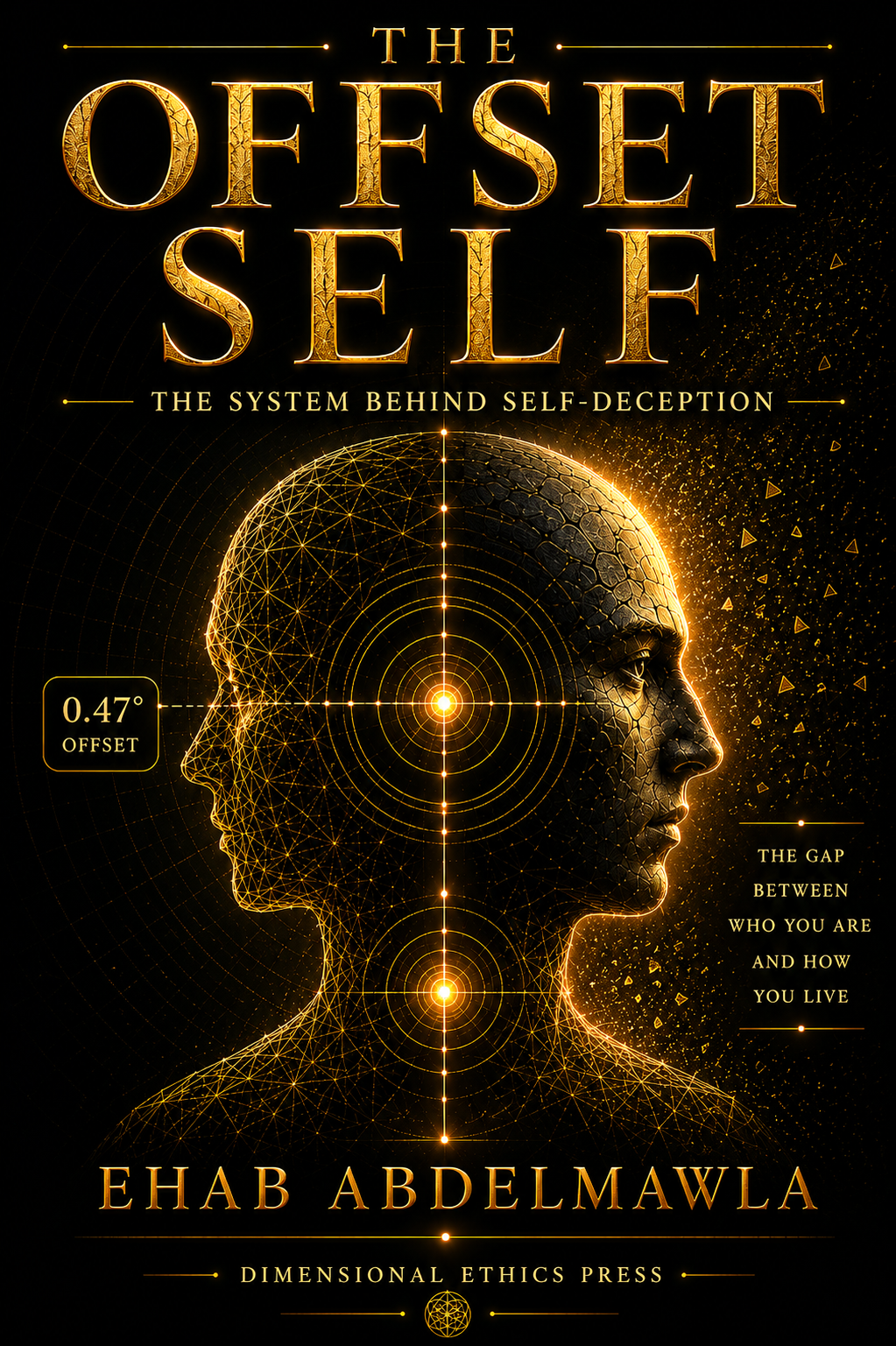
The System Behind Self-Deception
By Ehab Abdelmawla
The gap is small. The consequences are not.
Explore The Offset SelfNotes from the press, occasionally sent.
New books, essays, and announcements. No marketing. No noise.